Mobuoy Community Inquiry Procedures
Principles
The Inquiry will operate under the following principles:
- Independence: Free from state or corporate influence.
- Transparency: Open processes, public reporting and accessible information.
- Fairness: Equal opportunity for participation, respect for all voices.
- Credibility: Led by qualified, impartial experts.
- Accessibility: Processes and evidence channels designed to be inclusive of affected communities.
Procedures
The panel deliberating on Mobuoy will be selected by the steering committee. This selection will be informed by evidence, research and emerging plans over the initial consultation and evidence gathering processes. They will have practical and/or academic experience in the fields of environmental justice, regulation, governance, human rights and other related fields.
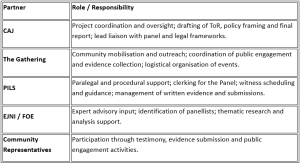
- Be supported by a secretariat team (PILS) to ensure procedural fairness, witness coordination and panel clerking.
- Hear from witnesses and review written evidence.
- Produce a final report (Autumn 2026) including findings, rulings and recommendations.
The Panel will gather evidence in three ways:
- Research: it will conduct its own research into the circumstances of the illegal waste dump at Mobuoy
- Written evidence: it will review evidence received through an open call for submission
- Oral evidence: it will hear testimonies and statements from a range of witnesses invited to speak to the panel at a set of public hearings.
Members of the public are invited to write to the Inquiry to tell the Panel how the illegal waste dump at Mobuoy has affected them, how it has affected their community, their homes, their families or otherwise. This is an opportunity for people living in the vicinity of this illegal waste dump to give their account directly.
Researchers are also invited to submit any evidence relating to the effects and impact of the illegal waste dump. If you are submitting work which is based on your own professional expertise, for example if you are providing a report on water sampling or contamination levels, please ensure that your submission includes a summary of your relevant qualifications and the methodology you have adopted.
An inbox for written and other forms of evidence submission has been set up: mobuoyinquiry@caj.org.uk.
Submitted evidence and testimony will be processed and prioritised by the CAJ and PILS, in coordination with partners, panellists and in line with the Terms of Reference.
If the Panel wishes to hear more detail, those making written submissions may be asked to speak at the Inquiry hearings.
The Community Hearing will be held over two days in 2026, modelled on a statutory inquiry format.
The Community Hearing will be open to the public and media, reflecting the principles of transparency and accountability. Recording of proceedings will be permitted for the public record and for the production of the final report, subject to the Chair’s discretion to restrict coverage in cases where testimony involves sensitive or personal material.
All participants and witnesses will be treated in accordance with safeguarding, confidentiality and data protection principles. Sensitive information will be handled with discretion and identifying details may be redacted where necessary to protect privacy and personal safety. All evidence will be processed in line with GDPR and good ethical practice for handling testimony.
The Mobuoy Community Inquiry will operate on the principles of fairness, respect and accountability in the handling of all information. All testimony and submissions must be made in good faith and, where possible, supported by verifiable evidence.
The Community Inquiry, its organisers and partners will take reasonable steps to ensure that all statements or allegations presented are framed responsibly, avoiding defamatory or unfounded claims against individuals or organisations.
Panellists, witnesses and contributors are reminded that the Inquiry does not have statutory powers and operates within the bounds of existing law, including defamation, whistleblowing and data-protection policies and legislation. Where potentially sensitive or contested evidence is raised, the panel reserves the right to request further verification, anonymise testimony or redact material to prevent harm.
The Community Inquiry will ensure equitable participation and representation across community backgrounds. Every effort will be made to ensure accessibility in both venue and format, including accommodations for language, disability and digital participation. The process will reflect the duties and spirit of Section 75 of the Northern Ireland Act 1998.
Inquiry procedures and the Terms of Reference may be reviewed and amended by consensus among the partner organisations as planning progresses. Amendments must preserve the independence, transparency and fairness of the process.